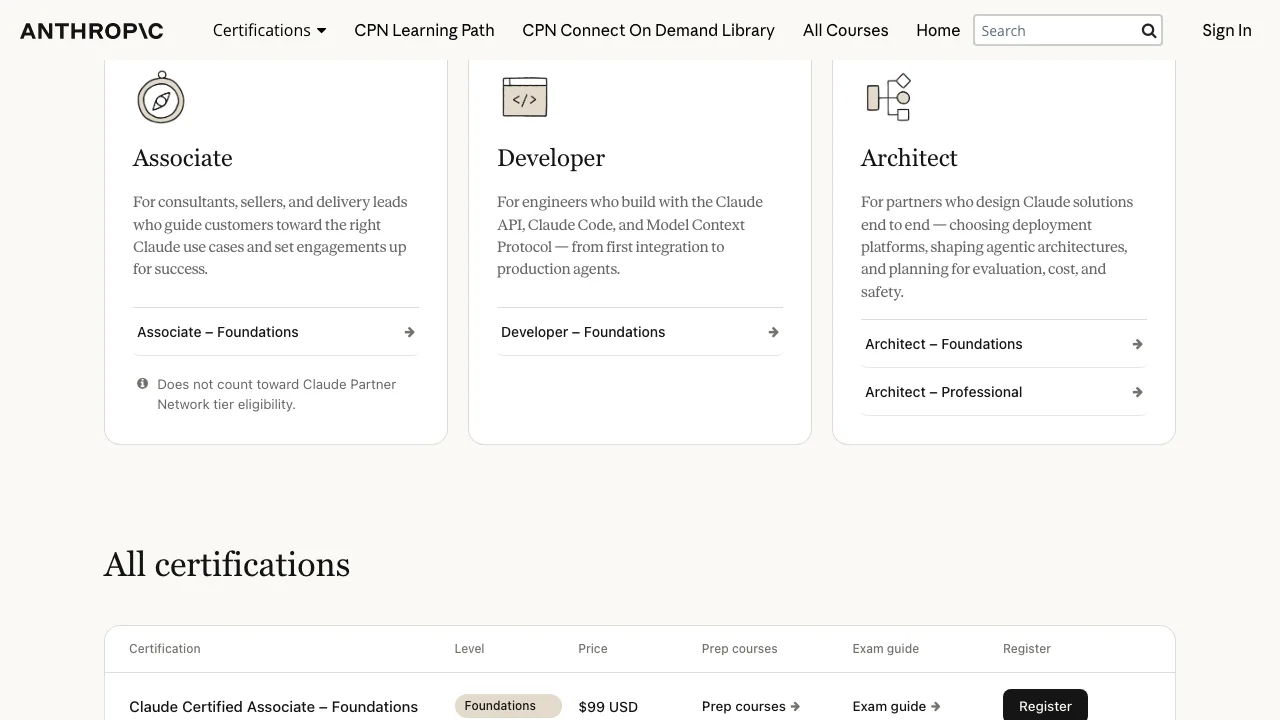
On 23 July 2026, Anthropic expanded its certification program to four role-based exams delivered through Pearson VUE. Four days later I pulled all four official exam guides and read them line by line.
These are proper proctored exams, and they already have scale behind them. Anthropic reports more than 36,000 certified consultants across 1,300+ organizations. But the most useful thing Anthropic published here is not the credential. It is the blueprint underneath it, and that part is free, public, and readable in an afternoon.
The short version
Anthropic runs four exams across three role tracks (Associate, Developer, Architect). They cost $99 to $175, run 120 minutes, and expire after 12 months. You cannot register with a personal email address. Certification is gated to Claude Partner Network companies, though joining that network is free for firms taking Claude to market. The exam blueprints are public PDFs and they are the single most useful free document in AI engineering right now: Anthropic's own weighted definition of what a competent Claude engineer knows.
What Anthropic actually launched, and when
The program is about four months old, not four days. The timeline matters because it explains most of the confusion online:
| Date | What happened |
|---|---|
| 12 March 2026 | Claude Partner Network launches with a $100M commitment and one exam: Architect – Foundations |
| 3 June 2026 | Services Track and Partner Hub launch. 10,000+ certified consultants reported |
| 23 July 2026 | Program expands to four role-based exams, delivery via Pearson VUE. 36,000+ certified |
Certified headcount went from 10,000 to 36,000 in about seven weeks. Anthropic also reports 400,000+ people have completed Claude training through the free Partner Academy this year.
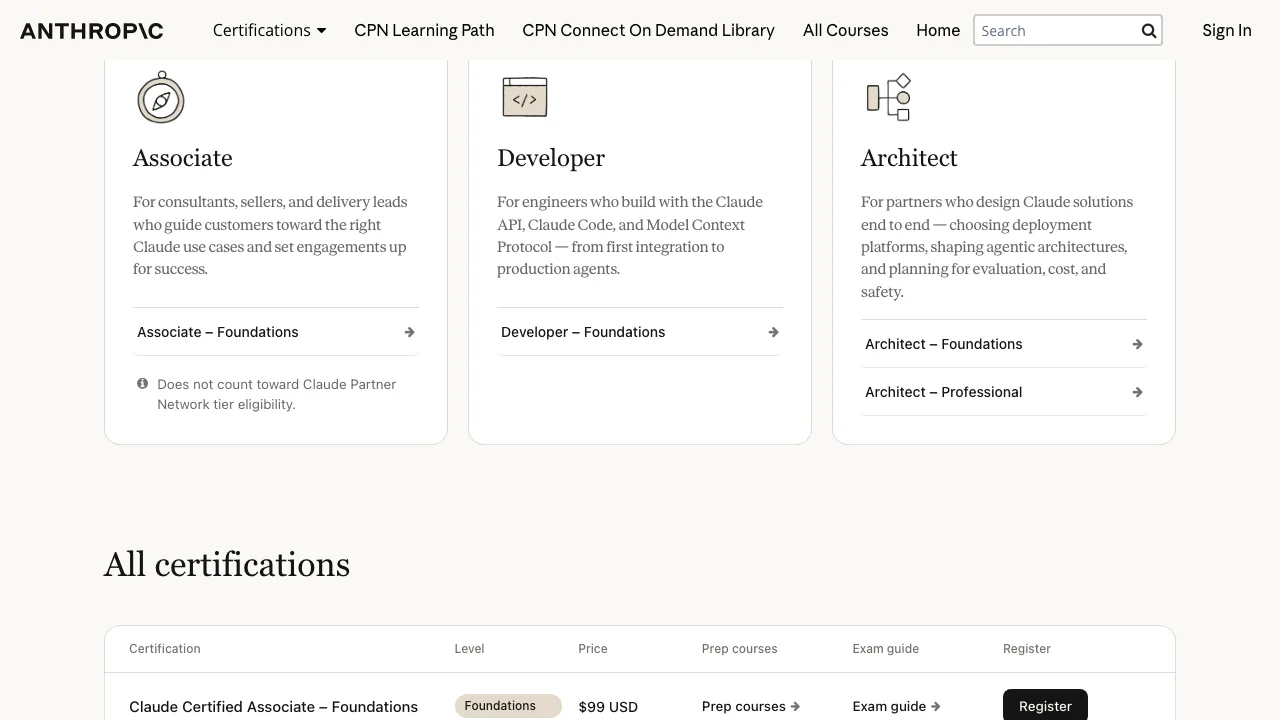
Notice the Architect column carries two entries. That is where the "three or four" disagreement comes from. Anthropic offers three role tracks but four exams, because Architect has both a Foundations and a Professional level.
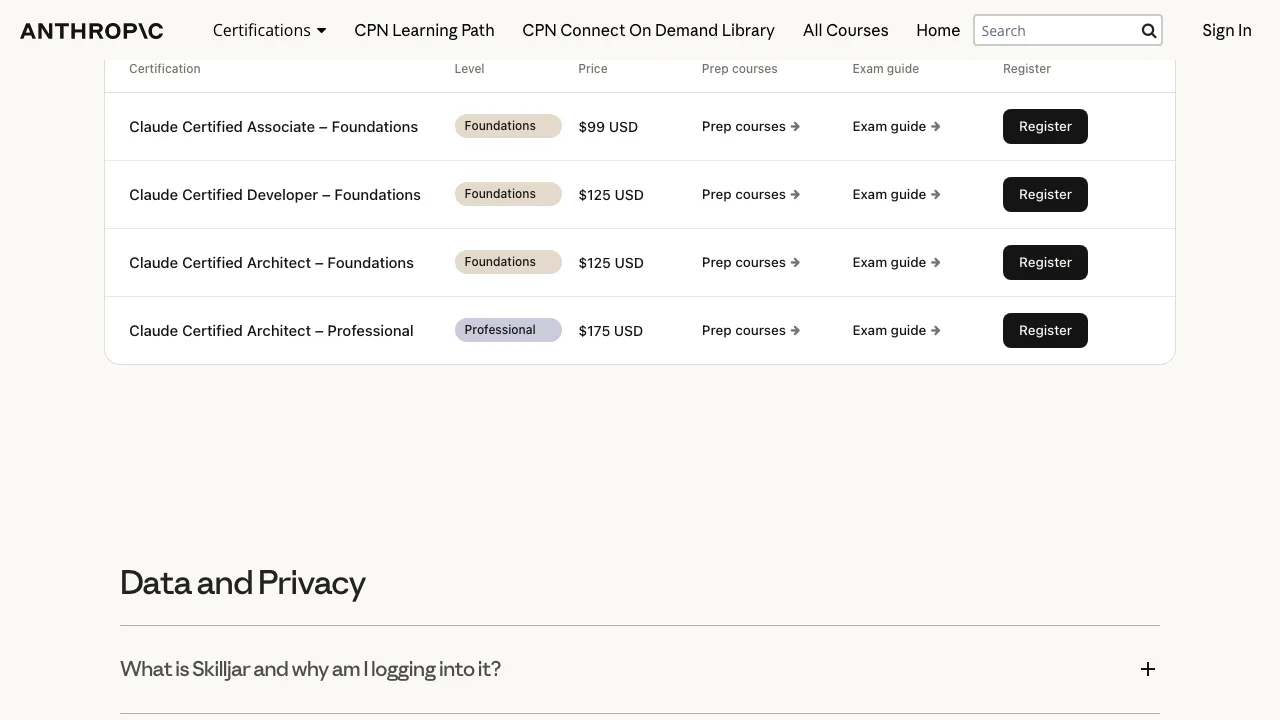
| Certification | Code | Items | Price | Level |
|---|---|---|---|---|
| Claude Certified Associate – Foundations | CCAO-F | 60 | $99 | Foundations |
| Claude Certified Developer – Foundations | CCDV-F | 53 | $125 | Foundations |
| Claude Certified Architect – Foundations | CCAR-F | 60 | $125 | Foundations |
| Claude Certified Architect – Professional | CCAR-P | 63 | $175 | Professional |
Every exam shares the same shape: 120 minutes of exam time (roughly 135 minutes of seat time including check-in), multiple-choice and multiple-response items, a passing scaled score of 720 on a 100 to 1,000 scale, and delivery by Pearson VUE either online-proctored or at a test center. Badges are issued through Credly. Exams are English only, and translation tools are prohibited during the session.
The eligibility rule most articles get wrong
This is the part that matters most and the part the prep-guide sites routinely botch. Several currently claim anyone can sit these exams. Anthropic's certification FAQ is explicit. Asked directly whether you need to work at a partner organization to take an exam, it answers:
"Yes. Certification is available to people at Claude Partner Network organizations. Registration requires a partner email address on a recognized company domain. Personal email addresses will not work."
And separately, on whether customers or non-partners can get certified: "Certification is currently available only to organizations in the Claude Partner Network."
Here is why the misinformation spreads. All four exam guides contain the sentence "There are no mandatory prerequisites or courses required to sit this exam." Writers read that as "no gate." It is not. That sentence concerns learning prerequisites, meaning no required course and no credential ladder. The organizational eligibility rule lives only on the FAQ page, and it is absolute.
Check this before you plan around the credential
If you freelance, work at a non-partner company, or want to certify on a Gmail address, you cannot register today. There is no individual path and no waitlist. Confirm your employer is in the Claude Partner Network before budgeting time or money for an exam you may not be able to book.
One fairness note that most critical takes miss: the gate is organizational, not financial. Anthropic states that getting started as a partner is free, and that any organization bringing Claude to market can join at the Registered tier. So an independent developer working through a small registered consultancy qualifies. A hobbyist on a personal address does not.
There is also a live incentive worth knowing. Select, Preferred, and Global Premier partners receive 50% off automatically at checkout, and Global Premier partners get 100% off all certification exams through 31 August 2026. If your company qualifies, these exams are free for roughly another five weeks.
The blueprint is worth more than the badge
Here is why this launch matters even if you can never sit an exam.
Anthropic published the complete content blueprint for each certification as a public PDF, with percentage weightings per domain. Those weightings came out of a formal job task analysis and content validation survey. That is assessment-industry language for "we surveyed people already doing this work and weighted the exam to match."
That makes these documents something rarer than a certification. They are a weighted, evidence-backed answer to the question every developer is quietly asking: what exactly am I supposed to know to stay employable in AI engineering?
Here is the Claude Certified Developer – Foundations blueprint in full:
| # | Domain | Weight |
|---|---|---|
| 2 | Applications and Integration | 33.1% |
| 5 | Model Selection and Optimization | 16.8% |
| 1 | Agents and Workflows | 14.7% |
| 6 | Prompt and Context Engineering | 11.0% |
| 8 | Tools and MCPs | 10.6% |
| 7 | Security and Safety | 8.1% |
| 3 | Claude Code | 3.1% |
| 4 | Eval, Testing, and Debugging | 2.6% |
Read that table twice, because it says something loud.
The surprise: Claude Code is 3.1% of the Developer exam
Ask a developer what an Anthropic developer certification tests and most will say Claude Code and prompt engineering. The blueprint disagrees.
Claude Code accounts for 3.1% of the Developer exam. Eval, Testing, and Debugging is 2.6%, the smallest domain on the paper. Meanwhile Applications and Integration alone is 33.1%, and its two largest sub-skills are Claude Application Design at 8.6% and Software Engineering Foundations at 7.4%. That second one covers REST APIs, JSON, async programming, version control, code review, and refactoring. Ordinary, unglamorous software engineering.
Prompt and Context Engineering combined is 11%. Security and Safety is 8.1%. On Anthropic's own weighting, securing a Claude integration counts for nearly as much as prompting one, and both are dwarfed by knowing how to build software properly.
There is a second surprise if you compare exams side by side. The Architect – Foundations blueprint weights Claude Code Configuration and Workflows at 20%:
| Architect – Foundations domain | Weight |
|---|---|
| Agentic Architecture and Orchestration | 27% |
| Claude Code Configuration and Workflows | 20% |
| Prompt Engineering and Structured Output | 20% |
| Tool Design and MCP Integration | 18% |
| Context Management and Reliability | 15% |
So the exam called Architect tests Claude Code roughly six times more heavily than the exam called Developer, at an identical $125 price. If deep Claude Code fluency is what you want measured, the Developer exam is not the one that measures it. That single comparison should change which exam a Claude Code specialist picks, and I have not seen it made anywhere else.
What this means for your learning plan
Anthropic is not certifying prompt jockeys. It is certifying engineers who can ship and defend production systems. Anyone who treated prompt engineering as a standalone career is looking at an 11% slice of one exam. Anyone who kept their software fundamentals sharp is looking at a third of it.
Does any of this actually protect your career?
The certification is too new to have moved anyone's salary. The skills it enumerates are a different story, and the labor-market data here is unusually clear.
The sharpest evidence is developer-specific. Indeed Hiring Lab reported on 8 July 2026 that US software development postings have risen about 15% since Claude Code launched in late February 2025, during a period when overall US job postings fell 7%. But the recovery is lopsided: 71% of that increase came from senior roles, and 37% came from jobs mentioning AI in the title. Software development postings still sit around 27.5% below pre-pandemic levels.
Read together, those numbers describe a barbell. Junior generalist demand has not recovered. Senior and AI-titled demand is what is growing.
Broader wage data points the same way. PwC's 2026 Global AI Jobs Barometer, built on more than one billion job advertisements across 27 countries, puts the AI-skills wage premium at 62%, up from 57% the previous year on PwC's own restated basis. PwC also found AI-specialist postings grew 68.9% between 2024 and 2025 while all postings grew 8.6%, roughly an eightfold gap. Lightcast, analyzing 1.3 billion postings, measured a more conservative 28% premium worth about $18,000 per year, and found 51% of AI-skill postings now sit outside IT and computer science entirely.
Read the adoption data honestly
Stack Overflow's 2025 Developer Survey (n=48,945) found 84% of developers use or plan to use AI tools and 51% of professional developers use them daily. Yet only 3.1% highly trust their output, while 45.7% distrust it to some degree. The field has adopted these tools far faster than it has learned to verify them. That gap, not the badge, is where a good engineer is still worth paying for.
None of this proves a Claude certificate raises your salary. It does establish that the competencies on the blueprint are the ones the market is repricing.
The 12-month clock, and the incentive behind the numbers
Every credential is valid for exactly 12 months from the award date. Anthropic ties the short window to how fast the technology moves. For context, AWS, Google, and Microsoft certifications typically run two to three years, so this is half the usual lifespan or less.
Renewal is handled fairly: renew on time and you review what changed, then complete a free, non-proctored assessment. Let it lapse and you retake the full proctored exam at full price. Anthropic also reserves the right to require a full retake if content changes substantially.
Retake rules are worth knowing before booking. Waiting periods escalate at 14 days after a first failure, 30 after a second, and 90 after a third, capped at four attempts per rolling 12 months per exam. Each attempt costs full price, and cancelling inside 24 hours forfeits the fee.
Now the part nobody writes about. Those 36,000 certifications are not 36,000 individuals who woke up wanting a badge. Anthropic's Services Track ties partner tier status to certified headcount, with the Global Premier tier requiring 1,000 certified practitioners. Partner pledges announced alongside the July expansion include Accenture at 50,000, PwC at 30,000, Capgemini, DXC, and UST at 20,000 each, Deloitte and KPMG at 15,000, and TCS, Cognizant, Infosys, and EPAM at 10,000 or more each.
A large share of this certification volume is firms purchasing tier eligibility. That is not a scandal; it is how partner ecosystems have always worked. But it does mean the headcount figure measures procurement as much as it measures skill. Treat "36,000 certified" as evidence the program is real, not as evidence the credential is scarce.
What to do if you cannot sit the exam
Most readers of this article cannot register today. That leaves the learning material, which is open to everyone and free.
Anthropic Academy hosts roughly twenty public courses at anthropic.skilljar.com, open to anyone with an email address. No partner domain required.
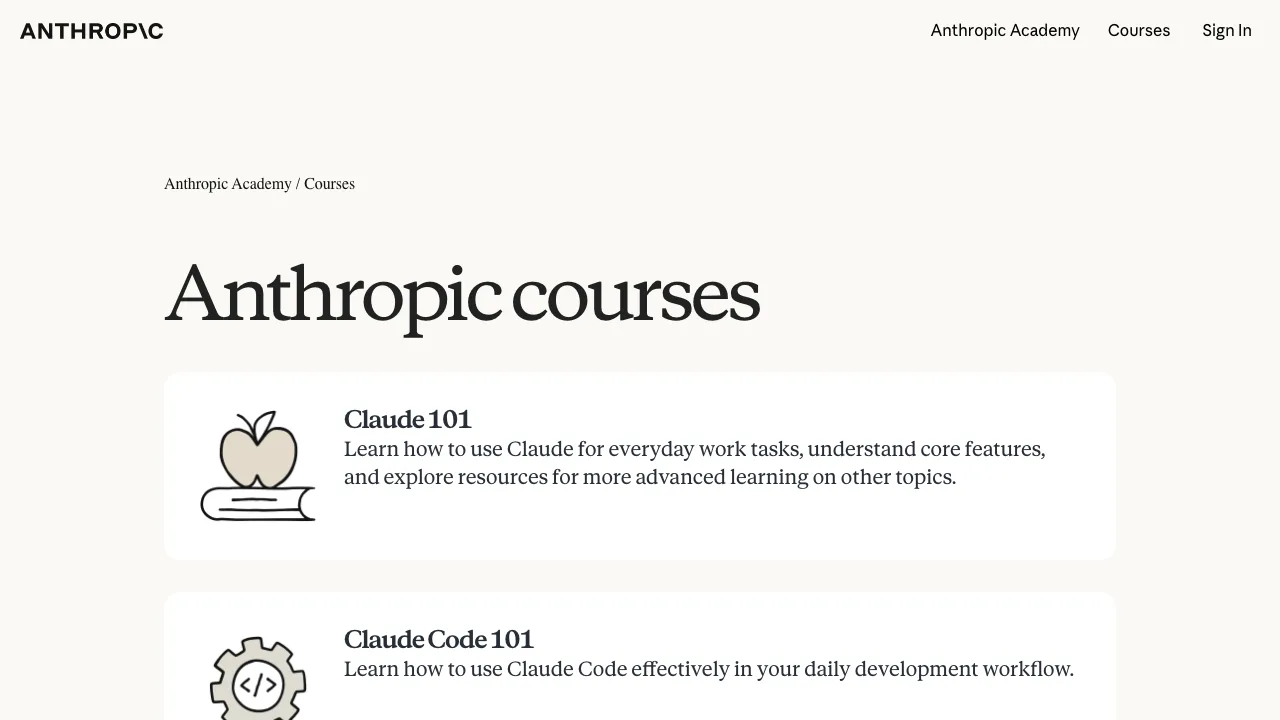
The catalog includes Claude 101, Claude Code 101, Claude Platform 101, Claude Code in Action, Building with the Claude API, Introduction to Model Context Protocol, Model Context Protocol: Advanced Topics, Introduction to Agent Skills, Introduction to Subagents, Introduction to Claude Cowork, and AI Fluency: Framework and Foundations. These are the same building blocks the certification prep paths draw on. Anthropic's own Developer prep path lists nine of them as recommended prerequisites.
The Developer prep path itself is marked free to register, and its five modules run to 774 minutes, about 12.9 hours of structured material:
| Prep module | Duration |
|---|---|
| MSO Foundations | 57 min |
| Production-Grade Prompting, Agents and Tool Use | 209 min |
| Claude Code, MCP and Integration | 142 min |
| Production Engineering, Evals and Security | 211 min |
| Accelerators and IP Contribution | 155 min |
The prep paths sit on the partner academy domain, so access may still depend on your account. The public Academy courses do not sit behind that gate.
One trap worth flagging: Building with the Claude API exists in two places. The Anthropic Academy version awards a certificate of completion. The Coursera version explicitly states that no certificates, credentials, or reports are awarded. If you want the completion certificate, take it on Anthropic Academy.
A 90-day plan reverse-engineered from the blueprint
You do not need permission to build the skills the blueprint describes. Weight your effort the way the exam does.
Weeks 1 to 4: integration, because it is a third of the exam
Build one real application on the Claude API. Not a demo. Something with streaming, proper error handling, retries, and multi-format input. Then move a latency-tolerant job to the Message Batches API and measure the cost difference against synchronous calls. Applications and Integration is 33.1% of the blueprint, and Software Engineering Foundations inside it is 7.4%, so treat clean code, version control, and review discipline as exam-relevant rather than optional.
Weeks 5 to 7: models, tokens, and money
Learn where the money goes. Token budgeting, cost modeling, prompt caching, and cache check-pointing sit inside Model Selection and Optimization, the second-largest domain at 16.8%. Get fluent in choosing between Opus, Sonnet, and Haiku against a stated quality, latency, and cost target, and be able to defend the choice out loud. This is the domain that makes you useful to a budget-conscious engineering manager.
Weeks 8 to 10: agents and tools
Build an agent with the Claude Agent SDK, then rebuild it as a custom agent loop so you understand what the SDK does for you. Then write an MCP server exposing a real internal service as tools. Agents and Workflows (14.7%) plus Tools and MCPs (10.6%) is over a quarter of the exam, and MCP server authoring has the clearest transfer value outside the Anthropic ecosystem since the protocol is open.
Weeks 11 to 12: security, then evals
Treat retrieved and user-supplied content as untrusted. Practice prompt injection mitigation, guardrail layering, secrets handling, and least privilege. Security and Safety is 8.1%, more than Claude Code and evals combined. Finish by building an eval suite that defines "done" for your agent and catches regressions. Small on the exam, disproportionately valuable in the job, and directly aimed at that 45.7% distrust figure.
Notice what is missing: no week is dedicated to prompt engineering tricks. Fold prompting into every week, the way the blueprint does.
So should you bother?
Pros
- Blueprints are public, free, and unusually specific about what to learn
- First-party credential from the model vendor, not a third-party course mill
- Proctored through Pearson VUE with a Credly badge, harder to fake than a completion certificate
- Prep material and the public Academy catalog cost nothing
- Free, non-proctored renewal assessment if you stay on schedule
- Free exams for Global Premier partners through 31 August 2026
Cons
- Partner-gated: personal email addresses cannot register at all
- Expires after 12 months, roughly half the lifespan of a major cloud certification
- Three of the four exams launched in July 2026, so employer recognition is still near zero
- Each failed retake costs full price, with waits of 14, 30, then 90 days
- English only, with translation tools prohibited during the exam
- Headcount is partly driven by partner tier requirements rather than individual demand
- The Developer exam barely tests Claude Code, which surprises most candidates
My honest read: chase the credential if your employer is a partner and will pay for it, especially before the Global Premier discount expires on 31 August. Chase the blueprint either way.
A credential this new cannot yet move a hiring decision, because nobody has calibrated it. But the competencies it enumerates were selected by surveying people already doing the work, and those competencies are exactly what the wage data says the market is repricing right now. The blueprint is a free curriculum with the vendor's own weightings attached, and that is the durable part.
Certifications expire in twelve months. Being the engineer who can ship a Claude agent that survives a security review does not.
Verify before you act
Everything here comes from Anthropic's official exam guides (version 1.0, July 2026), its certification FAQ, and its own announcements, all read on 27 July 2026. Three of the four exams are days old and Anthropic notes the guides may change without notice. Check the current guide before you register.
Sources
Anthropic official (all retrieved 2026-07-27)
- Partner Certifications: anthropic-partners.skilljar.com/page/partner-certifications
- Certification FAQ (eligibility, pricing, retakes): anthropic-partners.skilljar.com/page/faq-certifications
- Four role-based Claude certifications, published 23 July 2026: claude.com/blog/four-role-based-claude-certifications
- Claude Partner Network launch, published 12 March 2026: anthropic.com/news/claude-partner-network
- Services Track and Partner Hub, published 3 June 2026: anthropic.com/news/services-track-partner-hub
- Anthropic Academy public catalog: anthropic.skilljar.com
- Exam guides v1.0 (July 2026), PDF, for Associate, Developer, Architect Foundations, and Architect Professional, linked from the certifications page above
Labor-market research
- PwC, 2026 Global AI Jobs Barometer, published June 2026, retrieved 2026-07-27: pwc.com/gx/en/services/ai/ai-jobs-barometer.html
- Indeed Hiring Lab, "AI and Job Postings: From Destruction to Creation?", published 8 July 2026, retrieved 2026-07-27: hiringlab.org
- Lightcast, "Beyond the Buzz", published 23 July 2025, retrieved 2026-07-27: lightcast.io
- Stack Overflow 2025 Developer Survey, AI section, retrieved 2026-07-27: survey.stackoverflow.co/2025/ai
Building something real with Claude?
I help teams take Claude prototypes into production: agent architecture, MCP servers, cost control, and the security review that comes after.

Read more
Git Worktrees: How to Run AI Coding Agents in Parallel
Git worktrees let AI coding agents work in parallel. Measured: 0.12s to create one versus 1.20s to clone. Setup, the dependency tax, and mistakes to avoid.

11 Best Shadcn React Libraries (Plus 1 Bonus)
A developer's guide to the best Shadcn-compatible React libraries and UI kits—what they do well, trade-offs, ratings, and when to use each.

Dubai's Hidden Gems: Free Coworking Spaces That Rival Premium Memberships
Discover 5 exceptional free coworking spaces in Dubai, from mall hubs to creative galleries. Complete guide with access details, amenities, and insider tips for digital nomads and freelancers.